
Every advertiser eventually asks the same question in some form: where does this next dollar do the most work? For decades, that question had a fairly narrow set of answers: print, TV, radio, and outdoor. Today the options have multiplied, and with them, the confusion. Digital promises precision. Billboards promise scale. Bus wraps promise something in between, and are often overlooked. Here is an honest comparison of where each medium tends to earn its keep, and where it tends to fall short.
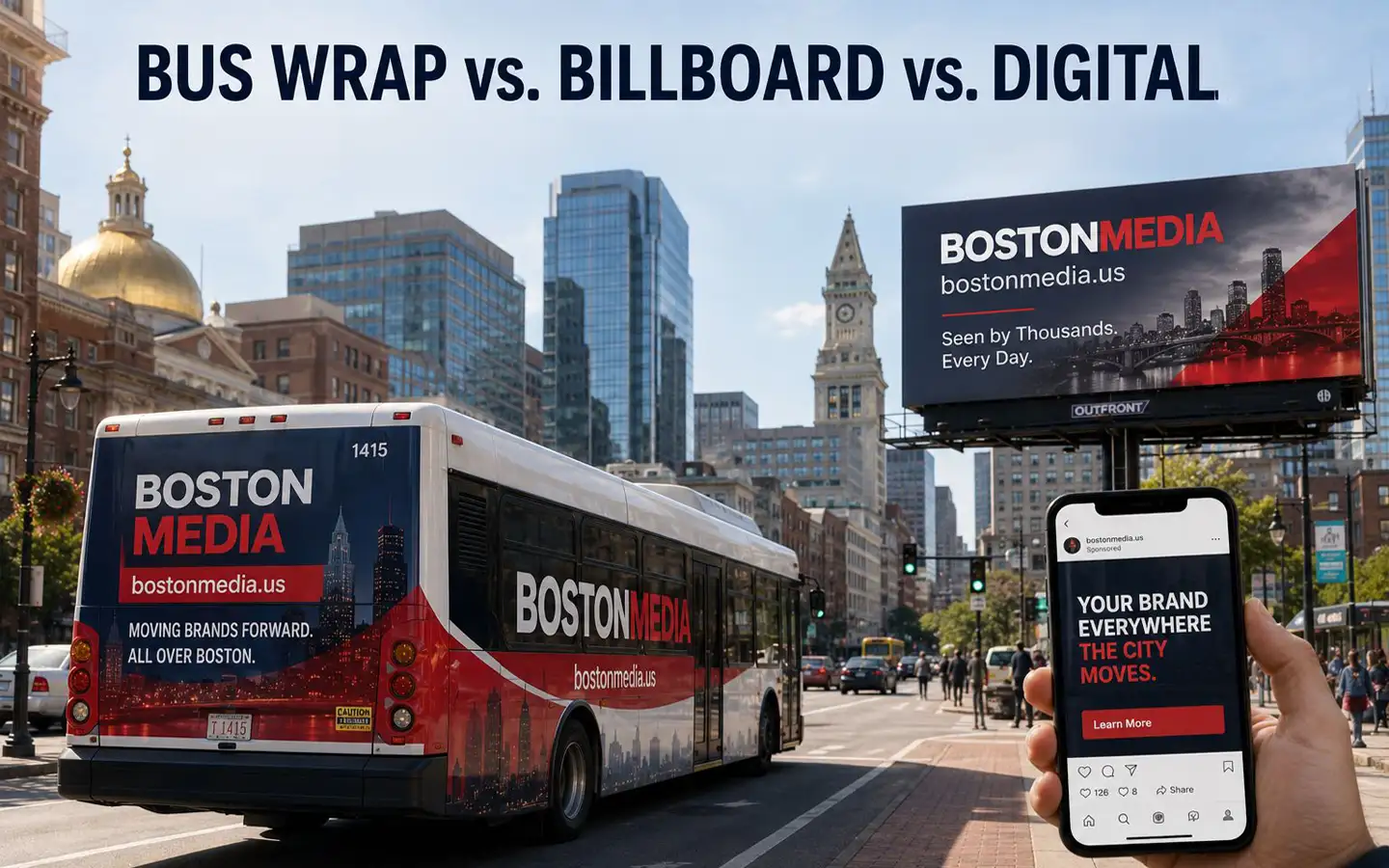
Digital: Precise, but Increasingly Crowded and Skippable
Digital advertising’s real advantage is targeting. You can put an ad in front of a specific age group, in a specific zip code, with a specific browsing history, and measure the click-through rate within minutes. For direct response campaigns, that precision is genuinely valuable.
Its weakness is one most advertisers already feel, even if they do not say it out loud: digital advertising is easy to ignore. Banner blindness, ad blockers, and the sheer volume of sponsored content competing for a single scroll all work against any individual ad’s odds of being noticed at all, let alone remembered. Digital also depends heavily on the platform’s own targeting and delivery algorithms, meaning the advertiser has less direct control over what “reach” actually means in practice.
Billboards: Scale, at the Cost of Context
A well-placed highway billboard delivers genuine reach, thousands of impressions a day for drivers passing at speed. But that speed is also the format’s central limitation. A driver has roughly three to five seconds to register a billboard, understand the message, and move on, which means billboard creative has to be radically simple, usually little more than a logo and a phrase. Billboards are also static. The same message, in the same location, day after day, which can lead to a kind of visual wallpaper effect for anyone who passes it regularly.
Cost per placement varies widely by market, but premium billboard locations in dense cities command some of the highest rates in outdoor advertising, often for a single fixed location that a portion of your audience will never actually pass.
Bus Wraps: Movement, Repetition, and a Lower Barrier to Entry
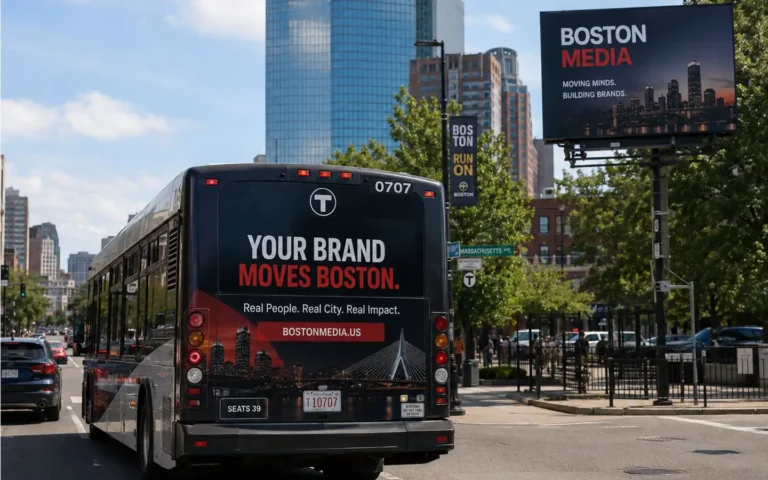
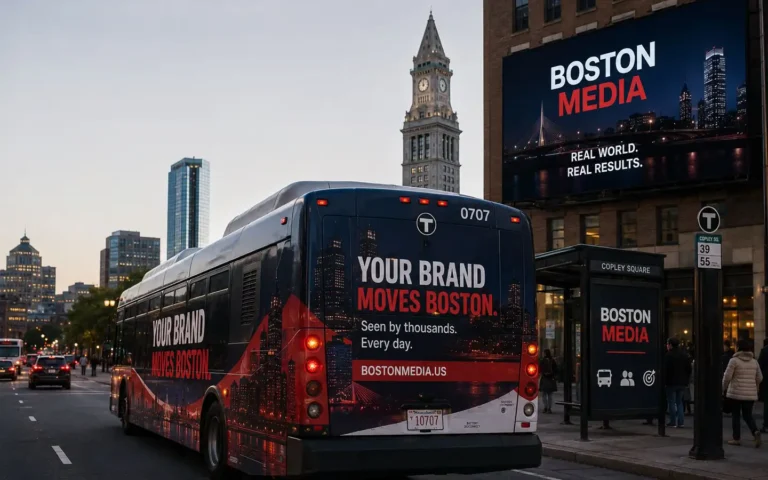
Bus wrap advertising sits in an interesting middle ground. Like a billboard, it is a physical, unskippable presence. But unlike a billboard, it moves, which means a single wrapped vehicle reaches dozens of different neighborhoods, intersections, and audiences over the course of a single day, rather than being fixed to one location. That mobility functions as a form of built-in reach expansion that a stationary billboard simply cannot offer at the same cost.
Bus wraps also tend to get more viewing time than a billboard. A pedestrian waiting at a stoplight, standing at a crosswalk, or seated in traffic next to a wrapped bus has considerably longer than three seconds to take in the design, which opens up more room for creative storytelling than a highway billboard’s glance-and-go format allows.
On cost, wrap campaigns are frequently more accessible than premium billboard placements in the same city, particularly for mid-sized advertisers who want sustained visibility without the price tag of a flagship billboard location. According to the Out of Home Advertising Association of America, transit advertising was the fastest-growing segment within out-of-home media in 2025, a signal that more advertisers are recognizing this value even as overall out-of-home spending continues to grow.
So Where Does the Budget Actually Go Further?
The honest answer is that it depends on the goal.
- If the goal is precise, measurable, short-term direct response, digital still does that job best.
- If the goal is broad, single-location awareness at scale, a billboard in the right spot can deliver it.
- If the goal is sustained, repeated, citywide visibility, especially in a dense, walkable market like Boston, a bus wrap campaign frequently delivers more real, attentive impressions per dollar than either alternative, because it combines a billboard’s unskippable physical presence with a level of movement and repetition that a fixed placement cannot match.
Most strong campaigns, in practice, do not pick just one. They combine mediums, using digital for precision and measurement, and out-of-home formats like bus wraps for the broad, repeated visibility that builds the brand awareness digital campaigns ultimately convert against.
If you are weighing a wrap campaign against other channels and want a straightforward read on what it would cost and what it could realistically deliver for your brand, reach out to our team, and we can walk through the numbers together.