
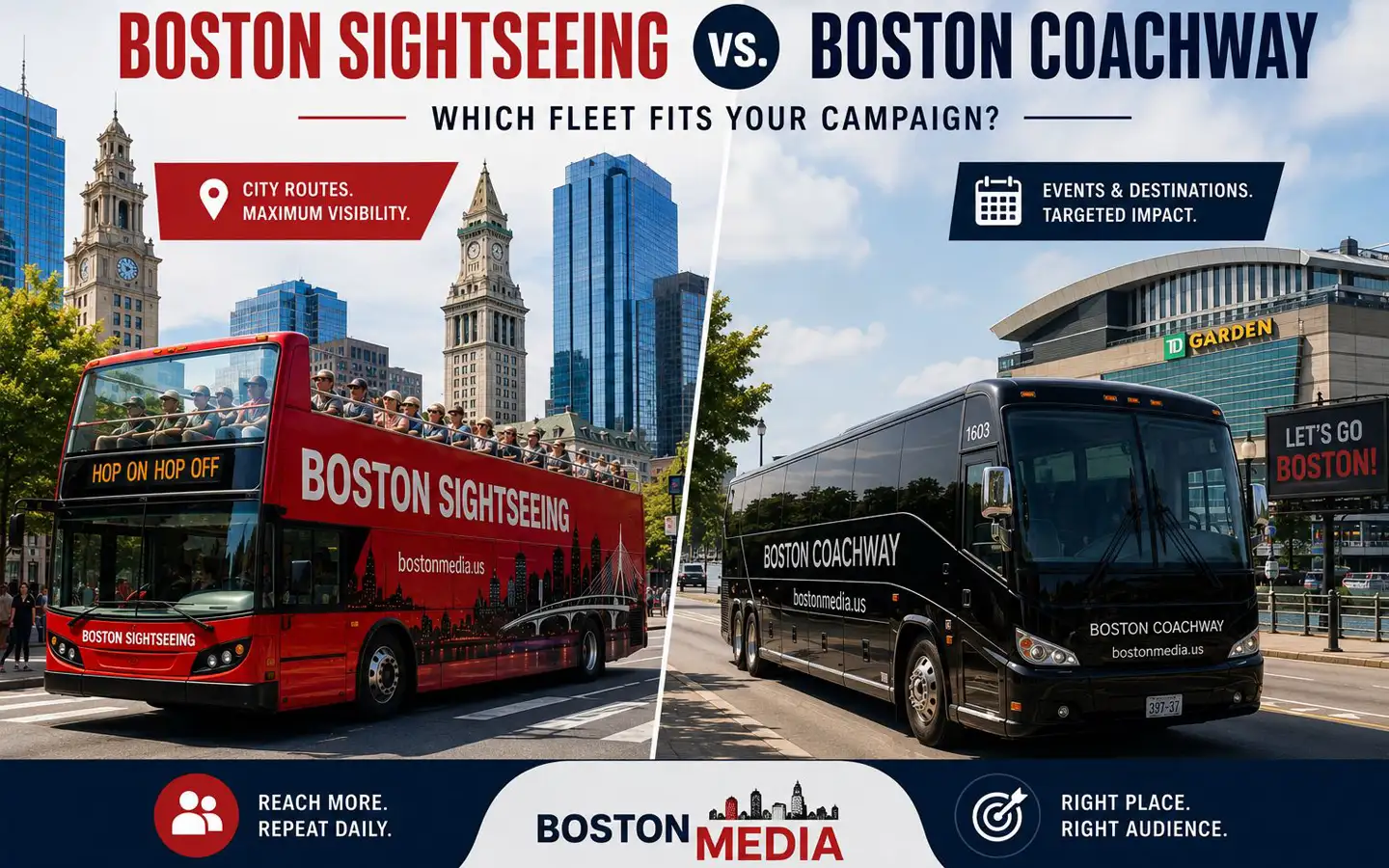
One of the first questions we ask every advertiser who comes to us is not “what’s your budget” or “when do you want to launch.” It’s simpler than that: who are you actually trying to reach, and where do they spend their time in this city? The answer to that question usually points toward one of our two fleets, Boston Sightseeing or Boston Coach Way, and understanding the difference between them is the fastest way to figure out which one is right for your campaign.
Boston Sightseeing: Constant Visibility in the City’s Densest Corridors
Boston Sightseeing operates our double-decker, open-top hop-on hop-off tour buses, running continuous routes through the neighborhoods that see the heaviest foot and vehicle traffic in the city: downtown, the Freedom Trail, Back Bay, the North End, and the waterfront. These are the corridors where locals commute, where visitors walk for hours at a time, and where a wrapped bus is guaranteed to pass the same intersections, the same crosswalks, and the same crowds multiple times a day, every day.
This fleet is the right fit for brands whose goal is broad, sustained awareness among a large, diverse, and constantly renewing audience. Because the routes are fixed and continuous, a Boston Sightseeing wrap builds frequency almost automatically; the same commuter or downtown worker will likely see the bus more than once in a single week without any additional targeting effort required. It also puts a brand in front of Boston’s substantial tourism audience, which makes it a strong option for consumer brands, hospitality, retail, and any advertiser whose customer base includes visitors as well as residents.
Boston Coach Way: Reach That Follows the Event, Not Just the Route
Boston Coach Way is our charter fleet, serving private events, group tours, corporate travel, school trips, and regional transportation throughout and beyond Boston. Where Boston Sightseeing’s strength is repetition along a fixed downtown route, Boston Coach Way’s strength is going wherever the audience already is: a stadium, a convention center, a regional event, a specific neighborhood tied to a client’s own customer base.
This fleet tends to be the better fit for advertisers with a specific event, moment, or audience segment in mind rather than a general awareness goal. A brand sponsoring or associated with a particular event, for example, can put a wrapped charter bus directly at that event, reaching an audience that is not just large but already primed to be paying attention to exactly the kind of message the brand wants to deliver. It is also the fleet of choice for advertisers whose target audience extends beyond the downtown tourist core, into the suburbs, regional destinations, or specific institutions like schools and corporations.
A Practical Way to Decide
If you are unsure which fleet fits your campaign, a few questions tend to clarify it quickly:
Is your goal general awareness across a broad, dense audience, or reach tied to a specific event or destination? General awareness points toward Boston Sightseeing. Event- or destination-specific reach points toward Boston Coach Way.
Does your customer base skew toward tourists and downtown visitors, or a more regional, local audience? Tourist and downtown-facing brands tend to perform well with Boston Sightseeing. Regionally focused brands, or those tied to a specific institution or event, often see stronger results with Boston Coach Way.
Do you want repeated exposure along a fixed route, or a single high-impact placement at a specific moment? Fixed route repetition is Boston Sightseeing’s core strength. High-impact, moment-specific placement is where Boston Coach Way excels.
Two Fleets, One Strategy
Many of the strongest campaigns we’ve run have not chosen one fleet over the other; they’ve used both. A brand might run a sustained Boston Sightseeing campaign for baseline downtown visibility, then add a Boston Coach Way placement timed to a specific event relevant to their audience, layering broad awareness with a sharper, moment-driven push.
There is no universally correct answer here, only the answer that fits your specific goal, audience, and timeline. If you want help thinking through which fleet, or combination of fleets, makes the most sense for your next campaign, get in touch with our team, and we’ll walk through it together.