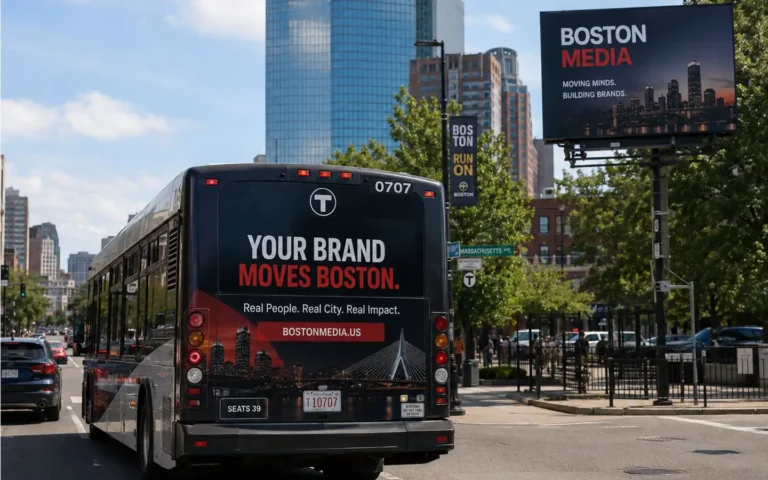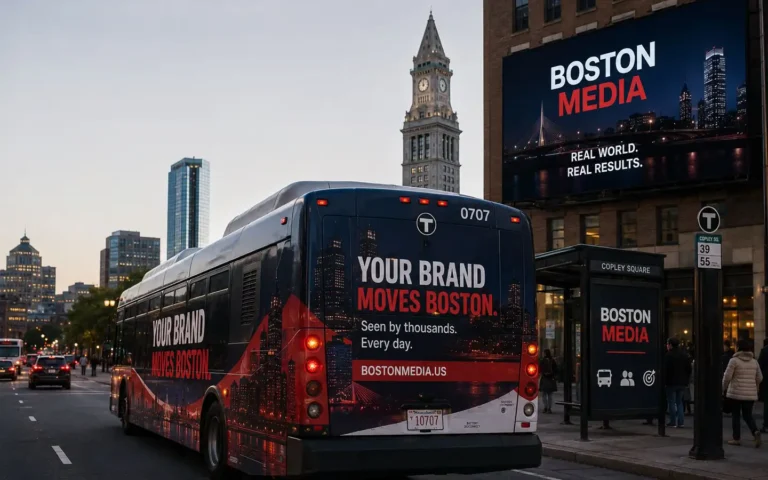

Boston is a city built for walking, for waiting at crosswalks, for sitting in traffic on Storrow Drive during rush hour. It is also, not coincidentally, a city where bus wrap advertising performs exceptionally well. Understanding why requires looking past the surface-level appeal of “a big colorful ad on a big vehicle” and into the specific mechanics of attention, repetition, and geography that make transit advertising different from almost every other medium available to a brand today.
Attention You Cannot Skip
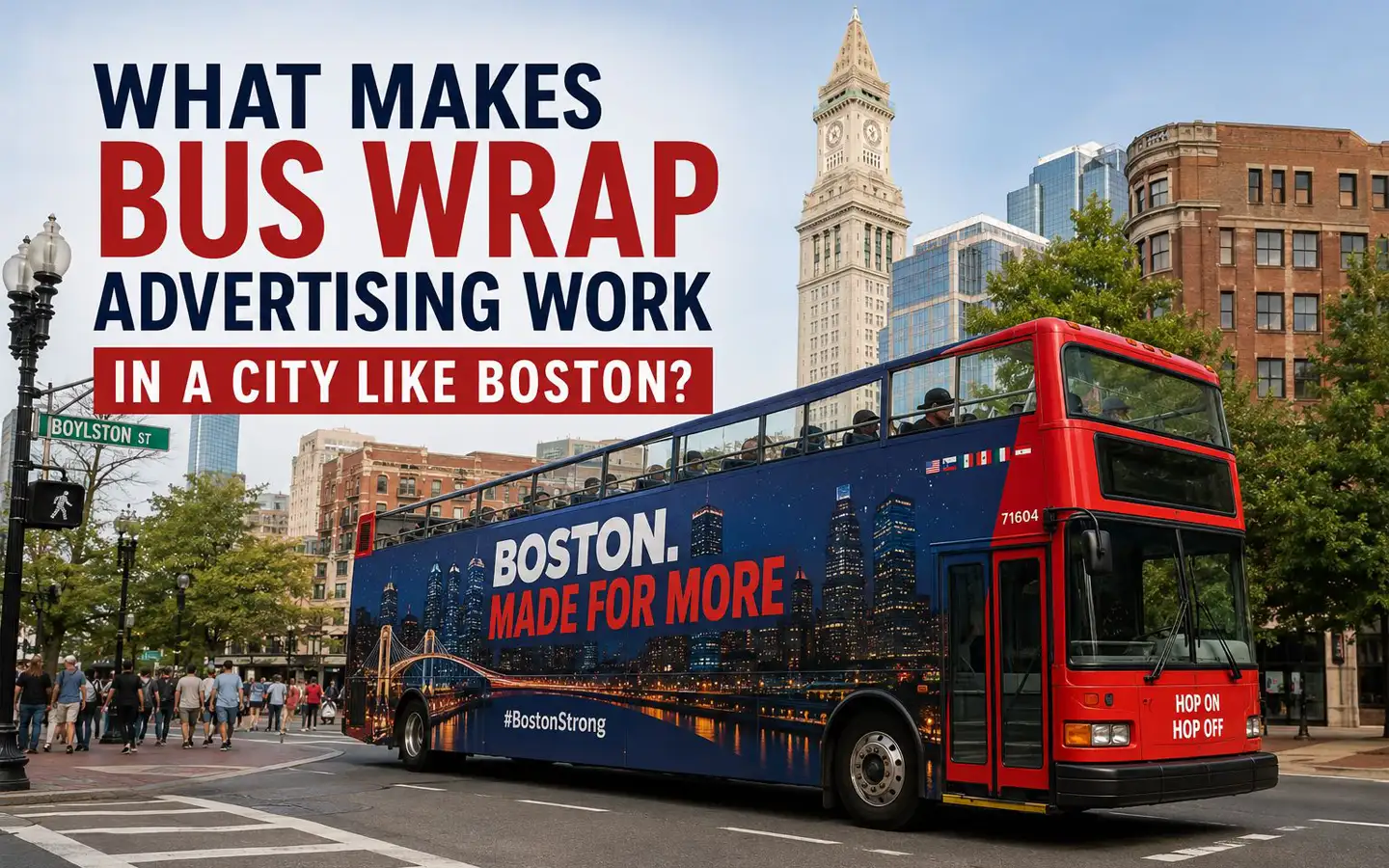
Every other form of advertising a person encounters today comes with an exit. A pop-up ad gets closed. A commercial gets muted or fast-forwarded. A sponsored post gets scrolled past in half a second. A bus wrap does not offer that option. If you are standing at a crosswalk on Boylston Street and a wrapped double-decker passes six feet in front of you, you see it. There is no skip button for a forty-foot vehicle moving through your field of vision.
This is one of the quiet advantages of out-of-home advertising broadly, and industry data backs it up. According to research from Clear Channel Outdoor and Kantar, out-of-home advertising drives an average 13.3 percent increase in ad awareness, a figure that outpaces television, digital, and connected TV. Unlike a screen-based ad, a wrapped bus is competing for exactly one thing: whether a person happens to be looking in its direction. In a dense, pedestrian-heavy city like Boston, the odds of that are very good.
Boston’s Density Does the Work for You
Bus wrap advertising works everywhere, but it works especially well in cities with Boston’s particular shape: compact, walkable, and layered with the kind of foot traffic that comes from tourism, universities, hospitals, and a downtown core that never fully empties out. A wrapped bus moving through the Seaport, past the Common, or along the Freedom Trail is not advertising into empty space. It is advertising into a constant, renewing stream of pedestrians, drivers, and transit riders who are already paying attention to their surroundings simply because that is what navigating a busy city requires.
This matters more in Boston than it would in a sprawling, car-dependent city where billboards along a highway are competing with a driver’s attention at 65 miles an hour. In Boston, people are moving slowly enough, and looking around enough, that a wrap has time to register.
Repetition Without Repetition Fatigue
One advantage transit advertising has over almost any other channel is that the same person can see the same ad multiple times, in different contexts, without the ad ever feeling repetitive in the way a digital retargeting campaign can. A commuter might see a wrapped bus near their office on a Tuesday morning, then again near a restaurant that weekend, then again from a rideshare on a Thursday evening. Each exposure reinforces the last, but because the ad is moving through the person’s actual life rather than following them through a screen, it reads as presence rather than pursuit.
This is part of why transit has become one of the fastest-growing segments within out-of-home media. According to the Out of Home Advertising Association of America, transit advertising grew faster than any other out-of-home category in 2025, even as the broader out-of-home industry posted its nineteenth consecutive quarter of revenue growth.
The Route Is the Targeting
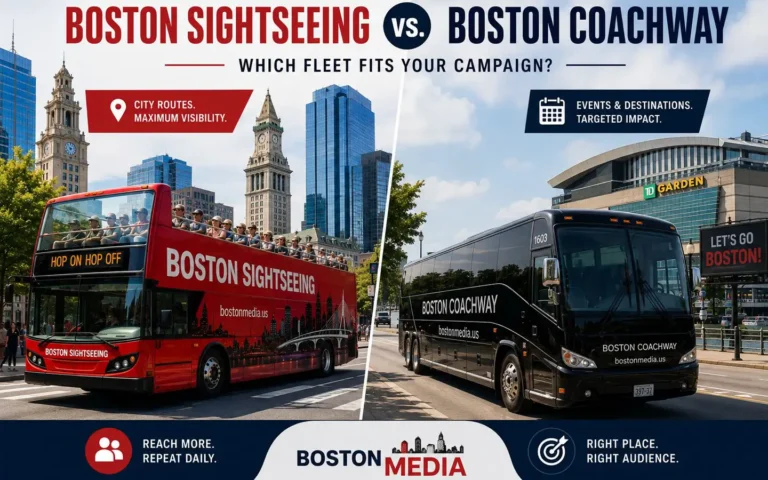
Digital advertising sells targeting based on demographics and behavior. Transit advertising sells something different but arguably just as precise: geography and routine. A brand that wants visibility among tourists and visitors gets a very different audience from a route through Boston’s sightseeing core than a brand trying to reach commuters, students, or event crowds tied to a specific neighborhood or venue. The route itself becomes a form of targeting, one that does not require any data collection, just an understanding of where a given audience actually spends its time.
What This Means for Advertisers
None of this means bus wrap advertising is right for every campaign or every budget. It works best for brands that benefit from sustained, broad-based visibility rather than narrow, one-to-one targeting, and for campaigns measured in weeks or months rather than days. But for a brand trying to build awareness in a specific city, among a specific set of neighborhoods, routes, or events, few media put a message in front of as many real, attentive people, in as many different moments of their day, as a wrapped bus moving through a city built the way Boston is.
If you are considering a wrap campaign and want to talk through which routes, timing, or fleet would make the most sense for your brand, get in touch with our team and we will walk you through it.